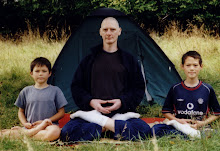
What is a true Buddhist? A true Buddhist might be one of those many thousands or millions of people in the world today who is searching for (or in some cases think they have found) the true meaning of Buddhism.
What then, really, is Buddhism? Buddhism is a concept which is most truly understood by non-buddha.
In total enjoyment of Sitting, non-buddha is not tainted by any kind of -ism. Non-buddha is especially not tainted by Buddhism.
Non-buddha eats and drinks the tea and toast of non-buddha, and shits the shit of non-buddha, but non-buddha does not look for any meaning in Buddhism -- because non-buddha knows that Buddhism is an utterly meaningless and bankrupt concept.
In the Nishijima-Cross translation of Shobogenzo you will find many uses of the words Buddhist and Buddhism. But you won't find any in my new translations -- unless one is carelessly included by mistake.
There is no word or compound in the whole of Shobogenzo that deserves to be mistranslated as Buddhist or Buddhism.
When BUTSU appears before a noun, as in BUTSU-E, there is no need to talk of the Buddhist robe. The kesa is the Buddha-robe, the robe of Gautama Buddha and all the buddhas.
BUKKYO, similarly, is the teaching of the Buddha, the teaching of all the buddhas, not a view, not an opinion, not anybody's Buddhism.
BUPPO, again, is the Buddha-Dharma, the Buddha's Truth of Sitting, the Method of Sitting of Gautama Buddha and all the buddhas. By calling it true Buddhism, real Buddhism, or any other kind of -ism, we slander it.
Twenty years ago when I translated BUPPO as "real Buddhism," I thought I was doing a favour to Gautama Buddha and all the Zen Patriarchs of India, China, and Japan. In fact I was just, in my youthful arrogance, trying to identify myself with the strongly-held opinions, and four-phased philosophical dogma, of Gudo Nishijima, who succeeded in convincing me, having succeeded in convincing himself, that he was the true world champion of real Buddhism.
But now I see that a person who considers himself to be a true Buddhist is just suffering from a delusion. The idea that Buddha and -ism might be compatible with each other, is completely misplaced. Any sentence prefaced by the words "We, true Buddhists...." can never be anything but a pack of lies, a heap of shit, pure falsehood.
So if any flock or herd of true Buddhists is reading this, I would like to vow to you, in all sincerity, as follows:
I, Mr Wrong, hereby vow that I will cross over you, True Buddhists, to the far shore of non-buddha, before I cross over myself.
Thursday, 29 May 2008


Wednesday, 28 May 2008
I, Mr. Wrong,...
I, Mr Wrong, wish to be clear in my intention to clarify wrong views of what Zen Master Dogen meant by full lotus sitting.
The negation of idealism, is not it.
The negation of materialism, is not it.
Philosophies of action, are not it.
Keeping the spine straight vertically as a means to bring the autonomic nervous system back to balance, is not it.
Soto Zen practice of shikan-taza, is not it.
What Master Dogen meant by full lotus sitting might be not anybody's view but just full lotus sitting itself -- physical sitting, mindful sitting, and just sitting.
A teacher who writes on his blog, "We, true Buddhists...." have such and such an understanding in regard to mindfulness, whereas they who have that understanding of mindfulness are non-Buddhists: such a teacher is not my teacher. I totally renounce the viewpoint of such a teacher. My sitting practise is utterly different from, nay, opposed to, his sitting practice.
Gudo's thesis is the thesis of "We, true Buddhists, have such and such an understanding of True Buddhism."
Without my going wrong in my endeavor to subscribe authentically to the thesis of True Zen Patriarch Gudo, there would be no chance of me, as Mr Wrong, being clear in regard to the proper anti-thesis to Gudo's thesis.
So I bow to Gudo, and thank him for putting his head above the parapet. I thank him for his heroic and courageous putting forward of his static true Buddhist thesis. And I say to Gudo: Go to hell, you old bastard, who fell so hopelessly in love with his own view, thinking it to be true Buddhism.
This is my attempt at a less fixed, less rigid, more dynamic anti-thesis.
But nobody comes from a more fixed, more rigid, more frozen-in-fear-ful place than me, with all the compensatory mechanisms I have constructed over the course of a lifetime to try to appear all right on the surface in spite of deep vestibular dysfunction within.
The insincere cloth-eared Paddy whom I slag off, the one who would like to bask in the warm glow of having asked the True Zen Patriarch a good question, is nobody but Mr Wrong himself.
FM Alexander said, "To know when we are wrong is all that we shall ever know in this world."
What FM said is true, at least for me it seems to work. For me, as one individual in my own chunk of spacetime, FM's approach seems to have opened up a kind of mission in life: to clarify, as Mr Wrong, what this wrongness is -- at least until such time as some more dynamic individual is able to see through my anti-thesis, truly expose me as the insincere fraud I am, and send me to join Gudo in that dustbin in hell that is reserved for the ashes of Zen teachers whose view turned out to be false.
Tuesday, 27 May 2008
Harry's Question On Mindfulness
Dear Mike,
In the West, from various Buddhist sources, we hear a lot about "mindfulness". It is widely considered a Buddhist practice to strive to attend to our daily tasks with an unbroken attention, which may be similar to the 'one-pointedness' developed in certain types of meditation.
What is your view on this type of practice?
Thank-you & Regards,
Harry.
I have been busting a gut to answer this question on my blogs for how many years already? Have you listened to a single word, you useless, conceited, cloth-eared paddy?
Venerable Hanrei? Do me a favour!
Dropping off all viewpoints
Was the sitting-zen he sat
Teaching conscious means-whereby:
I bow to him King Guat.
In other words, Harry, you can stuff your stupid question, asking for my view on mindfulness meditation, where the sun does not shine.
My intention is to point you, deaf and blind though you seem to be, in the direction of SITTING.
Master Dogen asked us to understand that there is MENTAL SITTING, as opposed to PHYSICAL SITTING. And there is PHYSICAL SITTING, as opposed to MENTAL SITTING.
Beyond physical and mental sitting, there is SITTING itself, which is totally and utterly opposed to the Soto Zen practice of "shikan-taza."
I have been busting a gut to clarify for you already this central pivot of Master Dogen's teaching. But you seem less interested in the truth that I have been telling, than in showing how clever you are with your presumptuous comments here and arse-licking tangential questions there.
Monday, 26 May 2008
Performing Buddha
Last night I briefly fell asleep on the sofa while watching a documentary about Russia, and so my late-night sitting-zen was fresher than usual. It occurred to me that I would like to translate GYOBUTSU not as "acting buddha" but as "grooving buddha" or "buddha in the groove." The original Chinese character GYO looks like railway lines; it has connotations, to me at least, of carrying on, easily, going with the flow, in a groove. And instead of "dignified behaviour" I thought I would like to translate YUIGI as "integrity."
I would like to get away from the manufactured dignity of professional Zen actors and performers. You know what I mean -- so-called Dharma-heirs who are lay men and yet call each other "Venerable So and So," and like to sign off with "Gassho" or protestations of their desire for universal peace and compassion. "Get away" is probably not strong enough. I would like to kick that kind of dignity in the bollocks.
But the danger with this line of thought is that it can all too easily turn into performing as non-buddha. But that is not it, either.
Is it that, in the middle way between the thesis of performing as buddha and the anti-thesis of acting as non-buddha, there is a synthesis -- a middle way of buddha grooving in the flow? No, that is not it, either.
In the background to the above musings was a conversation I had over the weekend with a Zen practitioner who is also a pianist, a musical performer. He asked me in a follow-up email if I thought there was more virtue in the lotus posture than in performing. My reply was this:
There is no virtue in the full lotus posture. Manifesting the full lotus posture is always the doing of a little performance -- a la Yoga, a la virtuoso concert pianist, a la virtuoso Alexander maestro.
The jewel in the lotus is sitting itself.
What I mean by sitting is just the right thing doing itself, and nothing but the right thing doing itself -- sitting that is in no way tainted by my fearful old self desiring to win the approval of others, by doing its little performance.
It is, as Nelly Ben-Or truly says, usually hidden from me.
With these thoughts still circulating in my body-mind, some time in the early hours of this morning I phoned Gudo Nishijima at his office in Ichigaya, as I usually would to clarify any point in Shobogenzo that I wanted to clarify. Invariably I would hear him singing out in his usual formulaic way, "Hello? Oh, please come!" But this time what I heard was a long pause, in which I realized Gudo was choking in his effort to fight back tears. Eventually he told me "Better .... carry on ... by ... yourself." There was another long pause in which I was aware of the possibility of saying some healy-feely words. But I didn't go down that path. I simply said, "OK" and put the phone down.
So all this is the background to what translated itself for me this morning -- under the title of "The Integrity of Buddha In the Groove."
"Dignity" or "Dignified Behaviour" would be closer to the literal meaning of YUIGI. But I like integrity. So integrity it is.
Thursday, 22 May 2008
Quick Realization of a Buddha's Body
In Shobogenzo Hotsu-Bodai-Shin, Kick-Starting the Bodhi-Mind, Master Dogen quotes four lines from the Lotus Sutra:
Constant spontaneous production of this thought:
"How to make living beings
Able to enter the supreme truth/Way/awakening,
And quickly realize a buddha's body."
What is a buddha's body like?
What is the body like of Sitting buddha?
What is the body like of buddha Sitting?
Is the neck stiff?
Is the chin being pulled backward and downward into the neck?
Is the spine held rigidly upright, necessitating abdominal breathing?
Are the shoulders and hips tight, as if pulling the limbs into the body?
OR:
Is the neck free?
Is the head being released up out of the body, like a ping pong ball on a fountain?
Is the back releasing upwards and outwards, in a lengthening and widening direction, so that the ribs move out and in easily and the breathing does itsef without any bother?
Are the limbs being released out of the body?
A few weeks ago I wrote on this blog a verse praising my own bodhi-mind. Afterwards I wondered if it was appropriate or not to praise one's own bodhi-mind. Probably it was another mistake.
Probably it arose out of an immature emotional reaction to being denigrated, to being accused of trying to identify so-called "Buddhism," and so-called "AT theory."
That immature emotional reaction, and this immature emotional reaction that I am expressing now, are probably not the bodhi-mind working.
But my journey from translating the Lotus Sutra in Japan, to Alexander work here in England, broadly speaking, has just been the working of the bodhi-mind. How else would I have arrived at the above questions?
Non-Establishment of the Bodhi-Mind
The Nishijima-Cross translation says, "Even if their form is humble, those who establish this mind are already the guiding teachers of all living beings."
But "establish" is completely the wrong word. It has connotations of stability, fixity. Nishijima selected that word, "establish," and Cross failed to boot the word into touch, into Row Z, where it belongs.
Brad Warner has written that the Nishijima-Cross translation of Shobogenzo is the best that there will ever be. On what basis does Brad make a comment like that, other than knowing that it might be music to the ears of Gudo Nishijima? That bit of Bradley Warner bullshit might be symptomatic of the same lack of clarity, the same rigidity of body and mind, that led Nishijima to select the word "establish" and that led Cross not to boot the word "establish" into Row Z.
"The Establishment of the Bodhi-Mind" might be the worst translation of HOTSU-BODAISHIN that there will ever be.
The original word, OKOSU in Japanese, would better have been translated as "rouse" -- a word that seems to be favoured by translators of ancient Pali texts, like the one recently quoted in Peter Clothier's blog.
But I would like to go further still in the direction of non-Buddhist dynamism and directness.
I would like to suggest the image of a grubby old biker who kick-starts a machine so that, grimy though the old biker may be, and old and rusty though the bike may be, by kick-starting the bike into action, the grubby old biker may lead a pack of millions to their true destination ....
"Crude in appearance though he may be, because he kick-starts this mind into action, he is the guiding teacher of all living beings."
When the old biker climbs back on his bike and kick-starts his old machine, what is established?
Nothing is established. Sweet FA is established. But something, for a while, is kick-started into action.
Saturday, 17 May 2008
Reaching Up, Not Clouding Over the Sun & Moon
FM Alexander wrote an enigmatic footnote in his second book, Constructive Conscious Control of the Individual, and then referred back to again it is his fourth and last book. He wrote: "I wish it to be understood that throughout this book I use the term conscious guidance and control to indicate, primarily, A PLANE TO BE REACHED rather than a method of reaching it."
Again, Alfred Tomatis said that (1) the ear is primarily the organ of balance (and therefore the ultimate arbiter of the middle way, which is an obvious fact but one generally not recognized by Soto Zen professionals, Buddhist theologians, Vipassana pyschologists and the like); and that (2) the ear is also a passive receptor of sound; but that (3) it is also possible for us to REACH THE LEVEL OF LISTENING.
The central principle in the work of both Alexander and Tomatis, as I understand it, is that the right thing does itself. The right thing does itself, as long as we can stop ourselves from doing the wrong thing -- namely, straining on the basis of deeply-held misconceptions, straining to have good posture, straining to listen, straining to hit the right note, concentrating. But this stopping of the wrong, when you go into it, is not so easy. There's the rub.
Still, this cause for optimism remains: A person well trained in the use of the whole self, or well trained in the use of the voice, or well trained in the use of the listening ear (the three ultimately amounting, once the use-voice-ear connection is openly and clearly understood, to the same thing), can reach the level of the right thing doing itself -- which might be called Listening, or Singing, or Chanting. There again, it might be called Sitting.
At the level of the right thing doing itself, the sense is one of effortlessness, ease, spontaneity, play.
What is this samadhi of effortless play?
To summarize what I wrote a few days ago, effort to be polite, or effort to be natural, or effort to regulate oneself, is not it. And so, my instinctive response to a two-faced Zen charlatan like James Cohen who tries to impose his standards of politeness on others, would tend to be an extremely rude one.
But that kind of effort is not it either.
There is bodily effort, based on feeling, to practise full lotus sitting.
There is mental effort, based on thinking, to practise full lotus sitting.
But even those kinds of effort are not it, either.
The most important point in Shobogenzo is simply affirmation of the fact that there is, going on up beyond physical and mental effort, full lotus Sitting.
The importance of clarifying that message is such that, much as I would like to devote this blog to slagging off James Cohen and the like, using abundant fruity language,.... I had better not.
Monday, 12 May 2008
Playing Keep-Up With the Sun & Moon
A monk asks Zen Master Chimon Koso, "What is the matter of buddha going on up?" The Master says, "The head of the staff is playing keep-up with the sun and moon."
This translation, which just popped into my head willy-nilly this morning, judged by the standard I have striven to uphold for most of my adult life , is totally unacceptable. "Playing keep-up with the sun and moon" in no way respects the literal meaning of the original Chinese character. It is just something I have come up with this morning, off the top of my head.
The original meanings of the verb in question, given in the Nelson Japanese-English Character Dictionary, include "contend for" and "make love to." ("The knob of the staff is fucking with the sun and moon"? Maybe a step too far.)
The Nishijima-Cross trying-to-be-as-literal/authentic-as-possible translation goes with "hoist up." But I like the idea that the old master thought that the head of his staff was playing keep-up with the sun and moon. So I am going with that.
How dare I take liberties like that with the translation of Zen Master Dogen's masterwork, Shobogenzo?
Only by not really giving a shit.
If you really, really give a shit, then get a source text, get a dictionary, and do your own authentic Buddhist translation. The translation I am doing now is a non-Buddhist translation, work that I am doing for the hell of it, and for the fun of it -- based not on trying to make the autonomic nervous system balanced by trying to keep the spine straight vertically, but based instead on the AT theory that trying to be right is not a path that goes on up to anywhere.
Saturday, 10 May 2008
Kicking Shobogenzo Up the Arse and Making It Come Alive
Yesterday, Friday, was an Alexander training school day and my younger son's 15th birthday, so I didn't do any translation work. This morning when I read what I had written on Thursday afternoon, I realized there was something wrong with it. It was somehow too convoluted -- somehow falling back into the old tendency of trying to be right, trying too hard to be literal. When I read it out loud, it didn't flow easily. So, while reading it out loud, I edited it with a view to making it more enjoyable for me to read out loud. I changed it so that I would have more of a chance, when reading it out loud, to make it sound as if I really meant it -- to make it sound as if I wasn't reading some old text out loud, but was rather, with eye, ear, and two resonating voices, just letting the actual truth be heard.
I realize that this is going to be one of the guiding principles of this new translation -- to be prepared to sacrifice the conscientiously literal in favour of the English wording that may help the listening/speaking/going-on-up process come alive.
Whether I succeeded or failed this morning, I will leave you to judge:
Ungo Doyo visits Tozan, who asks him: "What's your name, governor?" Ungo says, "Doyo." Tozan asks further, "Go on up and say again!" Ungo says, "If I were to reach up and say, it would not be named Doyo." Tozan says, "When I was in Ungan's order, our exchange was no different."
These words of master and disciple must be examined closely. Doyo says: "If I were to reach up and say, it would not be named Doyo." This means that Doyo is going on up. We should learn in practice that in Doyo just as he has come, there is something, not named Doyo, that is going on up. Doyo, having realized the truth that going on up is beyond being named Doyo, really is Doyo. But never say that there might be Doyo in his going on up. On hearing Tozan's words "Gon on up and say again!", if he were then to blurt out his enlightenment by exclaiming, "Reaching up, I would still be named Doyo!" just that would be his expression of going on up. Why do I say so? Because Doyo instantly springs into his brain in order to contain his body. And while thus concealing his body, he makes a show of himself.
In recent years I have realized that I have spent my life compensating in various ways for deep underlying dysfunction in my ear, and in all the innermost parts of the brain connected to the ear.
This kind of dysfunction is the primary root cause, in many cases, of difficulty not only with balance and listening but also with reading and spelling - in many cases, but not in mine. A peculiar thing is that, dysfunctional ears notwithstanding, I was precocious at reading and spelling as a young child.
Later on today, the mother a seven year old girl who is having problems with spelling is going to bring her daughter to meet me, to see if I can help her with her reading and spelling. This little girl, her mum tells me, is physically well co-ordinated, loves dancing, and is at home on the sports field, but reading does not come naturally to her. It has generally been more difficult for me to understand what is going on in the brain and body of a girl like this, because I, as a boy, never had any problems at all with reading and spelling.
So this morning the question I am thinking about is: why not -- why didn't I have problems reading and spelling, notwithstanding congenital ear dysfunction? I think the simple answer is that, from a very early age, my mother got me into reading aloud from picture books.
If you wish to understand why this activity is such a good one for co-ordinating the eyes, ear, voice, breathing, mind, et cetera, I strongly recommend Paul Madaule's book When Listening Comes Alive. I bought this book about seven or eight years ago, after meeting Paul through the good auspices of Peter Blythe of INPP Chester. I thought the book was so brilliant that I immediately lent it to a client who really needed to understand what the book said... but then I never got the book back. Having bought a copy already, I was reluctant to buy another one. That was a big mistake. I did finally get round to buying another copy a couple of years ago, but it is only in the past few weeks that I have got round to reading it closely. And, without putting too fine a point on it, the book is brilliant. Everybody who has ears and eyes and a voice should read it -- preferably out loud.
One of the recommendations Paul Madaule makes is that parents should talk to their children in the parent's own native tongue. The truth of this recommendation strikes me greatly. A Japanese person with a Japanese ear, when they read Shobogenzo aloud in English, will never do it justice. An English person with an English ear, when they read Shobogenzo aloud in Japanese, will never do it justice. If you have a French ear, you should look forward to the day when you can read Shobogenzo aloud in French. If you have a Spanish ear, you should look forward to the day when you can read Shobogenzo aloud in Spanish. If you have a Greek ear, you should look forward to the day when you can read Shobogenzo aloud in Greek. If you have a Martian ear, you should look forward to the day when you can read Shobogenzo aloud in Martian.
I have been secretly looking forward, for more than 25 years, to the day when I might be able to read Shobogenzo aloud in my own mother tongue, which is English. Some day soon, inshallah, I may do that. I may make an audio recording of these new chapters I have begun translating. I think I might enjoy that.
The years I spent in Tokyo, in many ways, were not good for my ears, not good for my voice, and not good for my soul. The occasional 3-day or 4-day breaks I had in Tokei-in temple in Shizuoka, in contrast, which were filled with the sounds of nature and filled with the sounds of slow chanting, were very good for my ears and very good for my soul.
Gudo Nishijima had a superb ear for Shobogenzo in Japanese and a superb voice for reading it aloud in Japanese. It was a great pity that, being so full of himself, it never occurred to the little control freak to entrust the English reading to his so-called "four Ejos" -- Jeff Bailey, Michael Luetchford, Larry Zacchi and me.
Unable to perceive the difference between glass and grass, or courteous and cautious, Gudo could not clearly make that distinction in his own speaking. In the same way, unable to perceive the difference between a control-freak's uptightness and spontaneous uprightness, Gudo could not clearly make that distinction in his own teaching. Gudo could not clarify the distinction between trying to uphold a right state, and spontaneously going on up.
But clarification of that distinction, with eyes, ears, voice, breath, skin, flesh, bones, and marrow, might be nothing but the lifeblood itself.
Thursday, 8 May 2008
Not The Matter of Buddha Ascending Beyond
I woke up this morning not feeling happy about "ascending beyond" as a translation of KOJO. I tried "reaching up" instead. I wanted to reflect this sense that there is in what Masters Tozan and Dogen are describing, as in the work of FM Alexnder and Alfred Tomatis, a condition of being, of sitting or of listening, which is spontaneous, automatic, effortless -- a plane to be reached.
So I went through the chapter changing "ascending beyond" to "reaching up"... and then I went through changing everything back again.
But then this afternoon, fortified by a midday nap (following the inspirational example of Master Koboku Hojo), I realized without doubt that "ascending beyond" didn't fit in Tozan's pithy exchange with Ungo Doyo. I asked for something more colloquial, and what came out was "going on up."
Yes: The Matter of Buddha Going On Up.
That is the translation that hits the target. It fits.
Some will say that it is a translation "based on AT theory." But to tell the truth, it is a translation arising out of 25 years of me straining ineffectually just to hear the voice of the Buddha.
Falling Into the Celestial Translator's Trap
Yesterday, after seeming to sail effortlessly through the translation of a large paragraph of The Matter of Buddha Ascending Beyond, I celebrated by adding a stupid comment which I later deleted, but shall own up to in this blog, where confession of my own stupidity more properly belongs.
FM Alexander wrote that what he meant by "conscious control" was primarily a plane to be reached. In the same way that unenlightened practitioners of Soto Zen are prone to think that Master Dogen's teaching is all about the process of sitting, as opposed to the goal of enlightenment, people tend to think that Alexander work is all about attending to the means, and not being interested in the end. But that is not the whole truth. FM was also interested in the end, which he called "conscious control," as primarily a plane to be reached.
Adam Nott, a very experienced Alexander teacher trained by Marjory Barlow, and a sly man in the tradition of G. Gurdjieff, once told me that he saw the Alexander process of inhibiting and directing as like a ladder leading up onto the plane of conscious control, and that we generally have a sense of when we are operating on that plane. But unfortunately, Adam continued, when we fall down off that plane we tend not to have any sensory register of having fallen down. We are prone to believe that we are still up there, happily ascending beyond, when in fact we are not.
As a piece of concrete evidence of what Adam was talking about -- having fallen off already without realizing it -- I shall copy and paste here my own stupid comment of yesterday:
People say that the Treasury of the Eye of True Sitting is baffling and impenetrable. Let me tell you something. To me, this morning, the meaning is just too obvious for words, and the translation of one large paragraph does itself in a matter of minutes without any bother at all. Probably that is because, thanks to the help of FM Alexander, Alfred Tomatis, and one or two of their descendants, I seem to have actually gouged out for myself the Eye of True Sitting.
FM Alexander said: "The right thing does itself."
Alfred Tomatis said: "The ear is the organ of balance, and also a passive receptor of sound. But you can also reach the level of listening."
Listening. Speaking. Sitting. Too simple. Very rare.
Yes, indeed. Too simple for the likes of me!
Wednesday, 7 May 2008
The Elgin Marbles
One thing I am not proud of is not having kicked up more of a fuss, hitherto, about the Elgin Marbles. It is the kind of issue that it is easy to leave to others. But if all fair-minded people take that stance, then the day is won by people of extreme views and sophisticated arguments.
A few years ago my local MP phoned me and asked if there was any pressing issue I would like to discuss. I said: "Yes, we should give the Elgin Marbles back to Greece." He said that was a first for him, to have a constituent raise that issue.
I haven't got a lot of complicated arguments to present about the Elgin Marbles. Leave complicated arguments to the brainy types at the British Museum, and to defenders of the British Empire/Establishment. Britain stole the Elgin Marbles from Greece. Britain should be in a hurry to give them back.
If there is any British tendency to be proud of, it might be fair play. So, if there are British people reading this blog who might be open enough (to the point of gullibility?) to be interested in the views and opinions of a person like me, one view I would definitely like to express is that we should give the Elgin Marbles back to Greece!
Subscribe to:
Posts (Atom)